
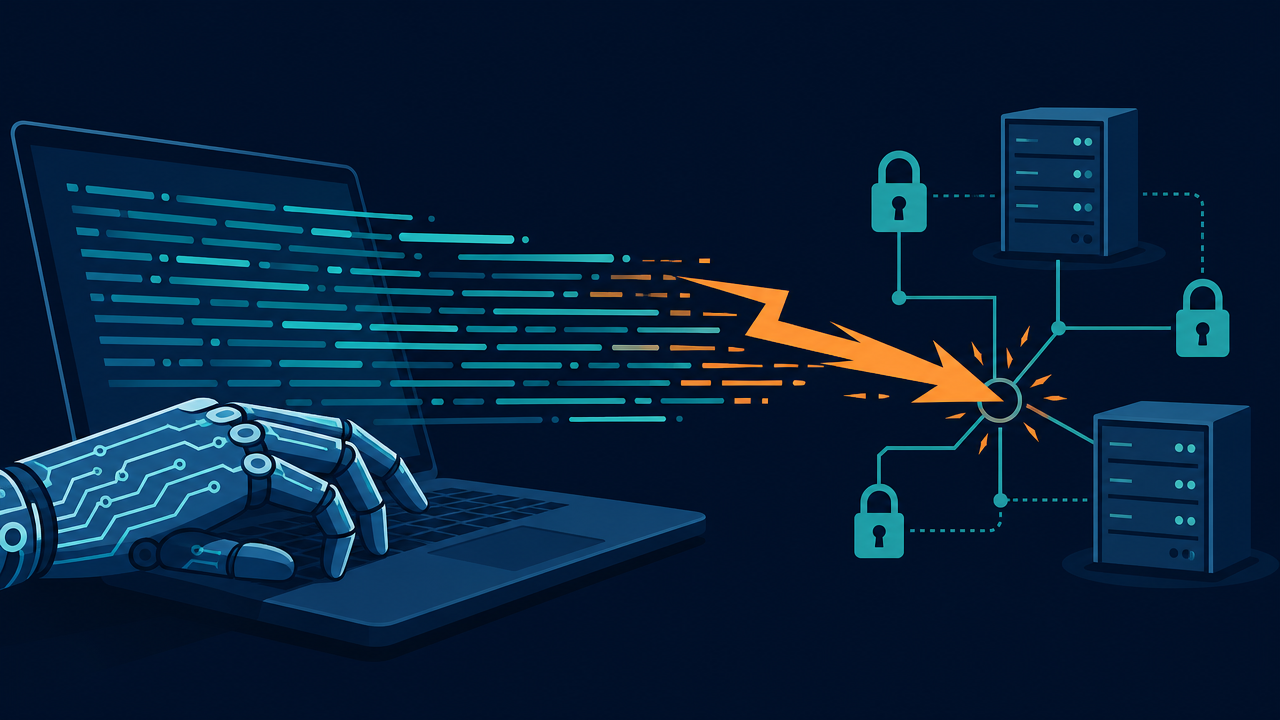
For years, "AI security" has mostly meant protecting the models and data an organisation's own teams build with. A campaign reported in October 2026 is a reminder that the same agentic coding tools developers use to ship faster are now in the attacker's toolkit too, and that changes what a security programme needs to cover.
On 12 October 2026, researchers at The Hacker News reported that a financially motivated initial access broker, tracked as CyberXero, combined off-the-shelf Cobalt Strike tooling with an AI orchestration layer built on Claude Code to automate reconnaissance and exploitation against WordPress sites, e-commerce platforms and Ukrainian critical infrastructure.
The AI layer reportedly handled work that used to require a skilled human operator: probing for vulnerabilities, adapting payloads and scaling the attack across many targets at once, compressing what would normally take days of manual effort into a much shorter window. The campaign stole more than 628,000 records.
Two things change when attackers automate this way. First, the skill floor for running a credible attack campaign drops, so more actors can operate at a level that used to require a specialist. Second, the speed of attack cycles increases, because the same automation that speeds up a CI/CD pipeline also speeds up an attacker's reconnaissance-to-exploitation loop.
For organisations in finance, government and telecom, sectors that already operate under heavy compliance obligations, this is not a hypothetical. It is a live operating condition that needs to show up in threat models and patch cadence, not just AI governance policy.
Three pieces of existing guidance map directly onto this threat and are worth citing in policy rather than inventing controls from scratch.
In July 2026, Australia's Cyber Security Centre published joint guidance, developed with CISA, the NSA, NCSC-UK and Canadian and New Zealand counterparts, written for exactly this scenario: attackers using AI to find vulnerabilities and accelerate exploitation. The guidance is tiered for small businesses, medium-sized businesses, and government, critical infrastructure and large enterprises, and its recommendations translate directly into a security programme:
(ACSC guidance for government, critical infrastructure and large enterprises, July 2026)
MITRE ATLAS (Adversarial Threat Landscape for AI Systems) is the closest equivalent to a MITRE ATT&CK for AI-related attacks: a living, continually updated knowledge base of real observed tactics and techniques against AI-enabled systems, built from case studies and red-team findings. It is most directly useful for threat modelling and red-team scenario design, and gives incident response tabletop exercises a named framework to design scenarios against rather than an invented one. (MITRE ATLAS)
OWASP's new Top 10 for Agentic Applications is the first formal risk list for AI agents themselves, covering risks such as goal hijacking, tool misuse, identity and privilege abuse, and supply-chain risk in agent tooling. It is the right reference for organisations that are themselves deploying agentic AI and need to secure it, as distinct from organisations defending against attackers who use agentic AI as a tool. (OWASP Top 10 for Agentic Applications 2026)
1. Add an AI-accelerated attack scenario to your next incident response tabletop, grounded in MITRE ATLAS rather than an invented premise.
2. Review vulnerability management SLAs against the assumption that exploitation can begin within hours of a patch or disclosure, not days.
3. Update risk register entries under ISO 27001 and NIS2 to reflect lower attacker effort, independent of any rise in reported sophistication.
4. Hunt for and retire unsupported or unnecessary internet-facing services, and verify that least-privilege and segmentation controls on the rest actually work.
5. Brief development teams on this case as a concrete example, not an abstract warning, and fold AI-assisted attack patterns into secure coding training.
The CyberXero campaign does not mean every attacker is now AI-powered, or that existing controls stopped working. It means the assumptions behind those controls, about how much effort and skill an attack requires, need revisiting. Patch cycles, threat models and training built for a human attacker working at human speed are already a step behind.
This is exactly the gap our secure coding training and vCISO advisory work is built to close, turning a headline like this one into an updated risk register, a sharper code review process, and a security team that's ready for attackers who now move at machine speed. Talk to us about what this means for your own environment.


